What Is a Promissory Note? Meaning, Types and Legal Rules
 Oliver Malachi Hoka
TL;DR: A promissory note is a signed, written promise to pay a set sum of money to a named person or to whoever holds the note. In the US, Article 3 of the Uniform Commercial Code (UCC) sets the tests for a negotiable note. Those tests shape how a note is sold and who can collect. See how lenders send loan agreements for eSignature.
A business owner lends money to a partner. A startup takes a loan from an investor. A parent helps a grown child buy a first home.
Each of these deals rests on one short paper: a promise to pay note. This guide explains what a promissory note means, the main types, who holds it and the US rules behind it. To draft one, use our guide on how to write a promissory note.
This guide explains general practice, not legal advice. Check your own note with a lawyer in your state.
What is a promissory note?
A promissory note is a written promise, signed by the person who owes the money, to pay a set amount. Think of it as a receipt in reverse: it records a payment still to come.
Article 3 of the UCC gives the terms. Section 3-103 calls a written, signed undertaking to pay a “promise”. It calls the person who promises to pay the “maker”.
The same section draws a clear line. A plain admission of debt becomes a promise only when the debtor also agrees to pay it. “I owe you 2,000 dollars” admits a debt, while “I promise to pay you 2,000 dollars by 1 March” is a promise.
What does a promissory note include?
Most notes answer the same few questions about the loan. The clearer each answer, the less room there is for a dispute later.
- Who owes the money (the maker) and who is owed it (the payee).
- The sum borrowed and any interest.
- When payment is due: on demand, on one date or in instalments.
- What happens after a missed payment.
- Any collateral that backs the loan.
Our promissory note writing guide, linked above, walks through each term with examples and common mistakes.
What is a negotiable promissory note?
Promissory notes that are freely transferable from one party to another are called negotiable promissory notes. Article 3 calls them negotiable instruments, and a note that meets its tests can pass from holder to holder.
Section 3-104 sets those tests. The note must hold an unconditional promise to pay a fixed amount of money, with or without interest. It must also do all of the following.
- Be payable to bearer or to order.
- Be payable on demand or at a definite time.
- Ask for nothing else from the maker beyond paying money, with a few exceptions such as collateral.
What makes a note non-negotiable?
A note fails the tests when it adds conditions or misses one of the points above. Under section 3-104, a note that states clearly that it is not negotiable is also outside Article 3.
That choice matters when a loan may be sold or pledged later. Article 3 rules on negotiation and transfer apply to negotiable notes only.
What types of promissory notes are there?
Notes are sorted by how they are paid, who can collect and what backs them. One note can belong to several types at once.
Demand notes and time notes
A demand note is due whenever the holder asks. Under section 3-108, a note that states no time of payment is also payable on demand.
A time note is due at a definite time, such as a fixed date or a set period. Instalment notes fall here too, with a date for each payment.
Order notes and bearer notes
An order note is payable to a named person, or to whoever that person names. A bearer note is payable to whoever holds it, as section 3-109 explains.
A note to “cash”, or a note that names no payee, is payable to bearer. That makes a bearer note easy to pass on, and easy to lose.
Secured notes and unsecured notes
A secured note is backed by collateral, such as a house, a car or business equipment. Section 3-104 lets a negotiable note include a promise to give or protect collateral.
An unsecured note rests on the borrower’s promise alone. Personal loans between family members are often unsecured.
Who is the promissory note holder?
The holder is the person who has the note and is entitled to payment under it. Under UCC section 1-201, that is the person in possession of a note payable to bearer, or to that same person.
Section 3-301 lets the holder enforce the note. A person who is not the holder can also enforce it in some cases, such as someone with a holder’s rights.
How does a note pass to a new holder?
Section 3-201 calls this transfer “negotiation”. A note payable to a named person needs that person’s indorsement and handover, while a bearer note passes by handover alone.
Under section 3-203, the person who receives the note gets the transferor’s right to enforce it.
What is a holder in due course?
A holder in due course took the note for value, in good faith and with no notice of a problem, under section 3-302. The note must also look genuine and complete.
Under section 3-305, such a holder takes the note free of some defenses the borrower could raise against the first lender. That is why buyers of loans care whether a note is negotiable.
How does a mortgage relate to a promissory note?
In a home loan, the note holds the promise to pay, and the mortgage pledges the house as security for it. The two papers work together, but the note comes first.
The US Supreme Court said so in Carpenter v. Longan in 1872.
“The note and mortgage are inseparable; the former as essential, the latter as an incident,” the Court wrote. An assignment of the note carries the mortgage with it.
Where are promissory notes used?
People use notes whenever money is lent and the terms need to be in writing. The sums range from small family loans to large business deals.
- Loans between family members or friends.
- Business loans and loans between related companies.
- Home loans, where a mortgage secures the note.
- Seller financing, where a buyer pays the seller over time.
- Startup funding from private investors.
Why does good faith matter in a promissory note?
The UCC asks both sides to act in good faith when they perform and enforce the note. Section 1-304 sets this duty for every contract the UCC covers.
Section 1-201 defines good faith as honesty in fact and fair dealing by reasonable business standards. A note can set out the terms, and good faith shapes how each side uses them.
Can you sign a promissory note electronically?
You can sign many notes electronically, but the rules depend on the type of note. Take extra care with a note that someone may sell or transfer later.
The federal Electronic Signatures in Global and National Commerce (ESIGN) Act leaves most of the UCC outside its general rule. A separate section covers electronic notes for loans secured by real property. It lets the parties sign those notes electronically.
Ask a lawyer before you e-sign a note that may be sold or pledged. For a simple loan between two people, check that your state accepts electronic signatures for that kind of note.
How do you send a promissory note for signature with BoldSign?
You upload the note, place the fields and send it to the borrower by email. The borrower signs on any device, and we keep an audit trail for the signed copy.
- Upload your promissory note file.
- Add signature, name and date fields for the borrower, and for the lender if both sign.
- Send the note and track each view and signature.
- Download the signed note with its audit trail.
Our eSignature audit trail logs each view and signature with times and internet protocol (IP) addresses. To reuse one note for many loans, create a template with roles such as Borrower and Lender.
Which BoldSign plan do you need, and what does it cost?
Any plan lets you send a promissory note for signature. The main difference for notes is how many templates you can save.
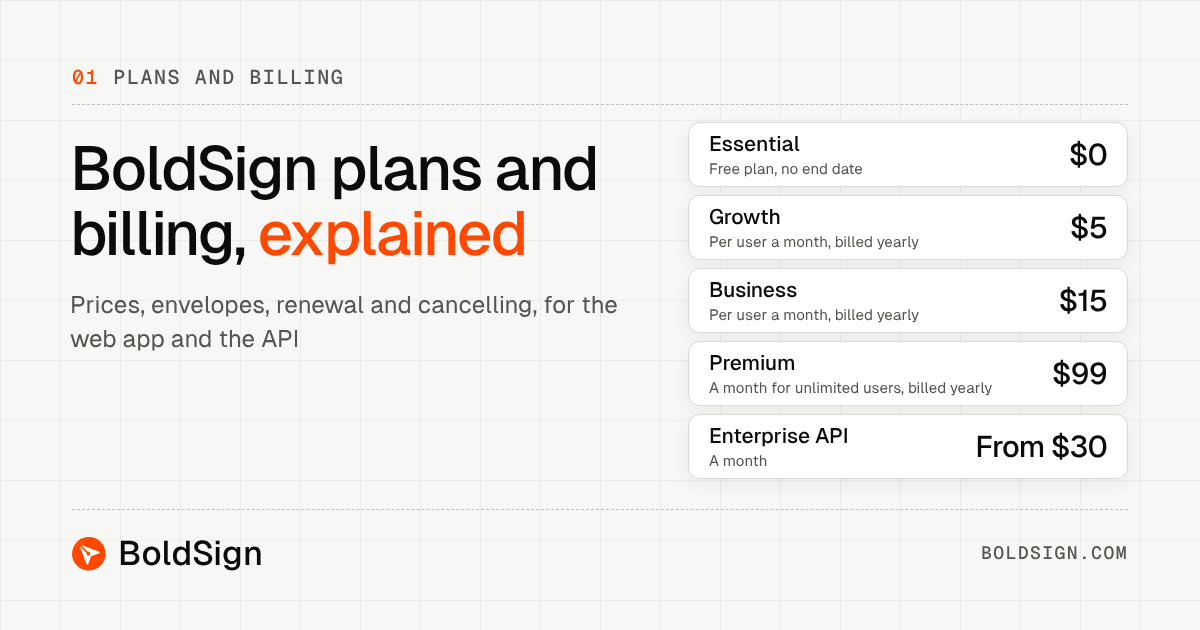
These prices are from the BoldSign pricing page in November 2026, in USD, billed yearly. The free Essential plan includes 2 templates, and the Growth plan includes 10 templates for $5 per user a month.
The Business plan costs $15 per user a month, and the Premium plan costs $99 a month for unlimited users. Both include unlimited templates. You can try a paid plan with a 30-day free trial.
Where do you go from here with your promissory note?
Pick the next step that fits where your note stands today.
- Start a 30-day free trial and send your first promissory note for signature.
- Read our guide on how to write a promissory note before you draft the terms.
- Book a demo or visit our support portal with a question.
Frequently asked questions
What is a promissory note in simple words?
It is a signed paper in which one person promises to pay another a set sum of money. It names the borrower, the lender, the sum and the due date.
What is the difference between a promissory note and an IOU (I owe you)?
A note holds a promise to pay, while a bare IOU only admits a debt. An admission of debt counts as a promise only when the debtor also agrees to pay it, under Article 3 of the Uniform Commercial Code.
Promissory notes that are freely transferable from one party to another are called what?
They are called negotiable promissory notes, or negotiable instruments. In the US, Article 3 of the Uniform Commercial Code sets the tests a note must meet to be negotiable.
Is a promissory note legally binding?
Yes, when it holds a clear promise to pay and the borrower signs it. A note with vague terms is harder to enforce, so check it with a lawyer before anyone signs.
Who can enforce a promissory note?
The holder of the note can enforce it in most cases. Article 3 also lets some people who are not holders enforce a note, such as someone who has a holder's rights.
Can a promissory note be sold to someone else?
Yes. A lender can sell or pass on a note, and the buyer then gets the seller's right to enforce it. A note made out to a named person also needs that person's indorsement to be negotiated.
Does a promissory note need a witness or a notary?
Article 3 does not list a witness or a notary among the tests for a note. Your state or your lender may set extra steps for some loans, so check those rules too.
Can you sign a promissory note online?
Yes, when the law that covers your note accepts electronic signatures. Federal law treats most Uniform Commercial Code records apart from other contracts, so ask a lawyer about a note you may sell later.

Oliver Malachi Hoka
Oliver Malachi Hoka is a detail-oriented professional with proven experience in office administration, logistics coordination, and HR support. He is skilled in drafting agreements, facilitating company policy training, and managing organizational documentation. Proficient in the Microsoft Office Suite, he excels at fostering teamwork, ensuring compliance, and improving efficiency in fast-paced environments. With strong interpersonal and communication skills, he has a proven track record of building stakeholder relationships and supporting organizational growth.
More posts by Oliver Malachi Hoka