Electronic Signature Buying Guide: Questions to Ask Before You Buy
 Caroline Dolly
TL;DR: An electronic signature buying guide is a list of questions to answer before you pay for a tool. Ask about features, legal records, security, limits, API access and total cost, then test the answers with your own documents. Our eSignature features page shows what each answer can look like.
You have a stack of contracts waiting for signatures and a shortlist of e-signature software. Every website says the tool is easy and secure. The real differences sit in plan limits, signer screens and the price of the next user.
This guide turns those differences into questions. Ask them on the demo call, then check the answers in a free trial before you buy.
What is an electronic signature buying guide?
An electronic signature buying guide is a set of questions that shows whether a tool fits your work. You answer them before you pay, not after.
Think of buying a used car. You ask about the mileage, check the service history and take a test drive before you hand over money.
Choosing between electronic signature platforms works the same way, with a free trial as your test drive. Lists of top electronic signature platforms look much alike, so your own questions do the sorting.
What features should I look for when selecting an e-signature service?
Look first for the features you will use every week. Rare extras matter less than the steps you repeat on every document.
- Self-signing, and sending one document to several signers in a set order.
- Reminders, expiry dates, and the option to revoke or reassign a request.
- Templates for the documents you send again and again.
- An audit trail that records who signed, when and from where.
- Signing that works on a phone or tablet, in the signer’s language.
Watch for hidden limits as well. Some electronic signature solutions cap the number of files per document, form fields or templates on lower tiers.
What questions should companies ask before choosing an eSignature solution?
Ask questions that a vendor can answer with a document, a page or a live demo. A vague answer to any of them is a reason to keep looking.
Are signed documents legally valid where we work?
The US has a federal law on this, the Electronic Signatures in Global and National Commerce (ESIGN) Act. It says a signature cannot be denied legal effect only because it is electronic.
Ask the vendor how it records each signer’s consent and identity. Our electronic signature legality pages cover the rules country by country.
How is our data protected?
Ask for a recent System and Organization Controls (SOC) 2 Type 2 report and how the vendor meets the General Data Protection Regulation (GDPR). Ask where your data is stored and whether you can choose the region. Our security, GDPR and compliance pages answer these for BoldSign.
What do the limits and costs look like?
Ask how many documents each plan sends a month, how many users it includes and what each extra user costs. Ask whether the price shown is billed monthly or yearly. Good answers come from a public pricing page, not a sales quote.
Who helps when something breaks?
Ask how you reach support, by email, chat or phone, and in which hours. Check the help articles, guides and release notes. Steady updates show that a product is still growing.
Which questions matter most for a small company?
A small team needs a digital signature for business that it can set up in an afternoon. Cost per user and monthly document limits matter more than advanced admin controls.
Ask whether there is a free plan you can keep after the trial. Ask what happens when you go over the monthly document limit. Our page on e-signature software for small business shows how we answer both.
Larger teams should add questions about team management, roles and permissions, and single sign-on.
Does your industry change what you need?
Your industry adds its own questions on top of the general list. Banks and real estate agents are two common examples.
Banks need strong signer checks and records an auditor can read. An electronic signature for banking should support ID verification and a full audit trail for account openings and loans.
An agent who needs an electronic signature for real estate contracts sends the same forms to buyers, sellers and other agents. Templates and signing on a phone matter most here. Our real estate solution shows that workflow.
When do you need an e-signature API?
You need an e-signature API when signing should happen inside your own app or website. Your users then never switch to another tool to sign.
An API e signature setup suits a software company, an online lender or a booking platform. Your team sends e signature documents from your product and gets the signed files back automatically. Our eSignature API page explains how it works.
What should you check in a digital signature API?
- Clear API documentation with sample requests and responses.
- Software development kits (SDKs) for the languages your developers use.
- Embedded sending and signing inside your own pages.
- Webhooks that tell your app the moment a document is signed.
- A free sandbox to test every call before you go live.
We provide SDKs for five popular programming languages. A digital signature API free sandbox lets your developers build without paying first. Our sandbox documents carry a test watermark and are deleted after 14 days.
Choose a signature API early when signing is part of your product. Moving years of documents to a new vendor later takes far more work.
How do you test e-signature software before you buy?
Run a short, planned trial instead of clicking around. A plan shows you how the tool handles your real work.
- Pick the three documents your team sends most often.
- Upload each one, place the fields and save it as a template.
- Collect electronic signatures from two colleagues, one of them on a phone.
- Download the signed file and read its audit trail.
- Ask support one real question and note how fast the answer comes.
Compare e signature solutions and other e-signature solutions on the same five steps. You then judge each tool on facts, not on its homepage.
Which BoldSign plan fits, and what does it cost?
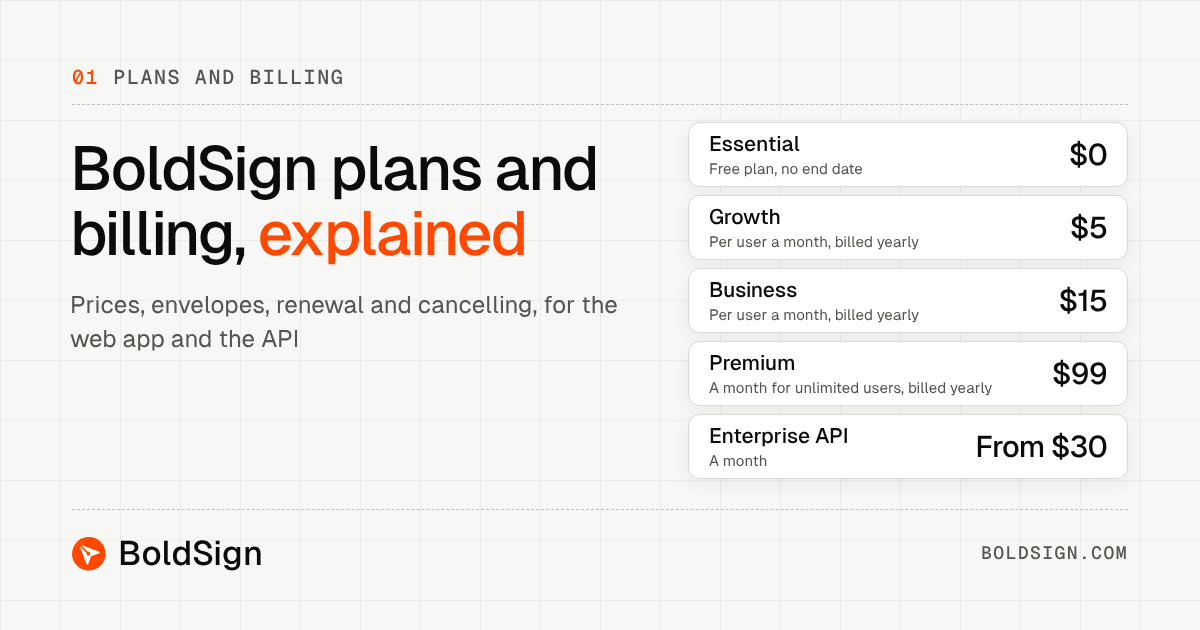
We publish our prices on the BoldSign pricing page, in US dollars and billed yearly. Our Essential plan is free and sends 25 envelopes a month with 2 templates.
The Growth plan costs $5 per user a month and adds 10 templates and 50 envelopes a month. The Business plan costs $15 per user a month.
It adds unlimited envelopes and templates, team roles and permissions, and single sign-on. It also adds delivery by text message or WhatsApp, ID verification, and HubSpot and Salesforce integrations.
The Premium plan costs $99 a month for unlimited users and 250 envelopes a month. The Enterprise API plan starts at $30 a month with 40 envelopes, then $0.75 per extra envelope. It includes live API access, webhooks and embedded signing, and every plan includes a free sandbox.
How do you start comparing tools today?
Take your three most-sent documents and run the five-step test on your shortlist. These links help you begin with us.
- Start a 30-day free trial and send your first document today, with no credit card required.
- Book a demo and bring your list of questions.
- Contact our support team to see how fast we answer.
Frequently asked questions
What features should I look for in an eSignature solution?
Look for signing order, reminders, templates and an audit trail on every document. Then check that signers can sign on a phone and that you can add a signer check, such as an access code.
I work at a company with 1-249 employees. What questions should you ask when choosing an eSignature platform?
Ask how many documents each plan sends a month, what an extra user costs and whether a free plan exists. Also ask how you reach support and what a yearly plan costs in total.
Are electronic signatures legally binding?
Yes, when the signer agrees to sign electronically and you keep an accurate record. In the US, federal law says a signature cannot be denied legal effect only because it is electronic.
Is there a free e signature API for testing?
Yes. We offer a free API sandbox account with no credit card required. Sandbox documents carry a test watermark and are deleted after 14 days.
How long should an eSignature free trial last?
Long enough to send your own documents to real signers and see the signed copies come back. We offer a 30-day free trial with no credit card required.
Which security audits should an eSignature vendor have?
Ask for a System and Organization Controls (SOC) 2 Type 2 report. We have completed a SOC 2 Type 2 audit, and you can store your data in the US, EU, Canada or Australia.
Should signers need an account to sign a document?
Ideally, a signer opens the link and signs with no sign-up step. Ask the vendor to show you the signer's screens on a phone during the demo.
How much does BoldSign cost?
Our Essential plan is free. Growth costs $5 per user a month and Business $15 per user a month, billed yearly. Premium is $99 a month for unlimited users.

Caroline Dolly
Caroline Dolly is a technical writer at BoldSign who simplifies complex concepts into clear, engaging content. She creates tutorials, help articles, and product documentation, ensuring information is accurate and accessible. Connect with her on LinkedIn.
More posts by Caroline Dolly