Order Form vs Master Agreement vs SOW: How They Work Together
 Oliver Malachi Hoka
TL;DR: A master agreement sets the legal rules for a business relationship. An order form records a purchase, and a statement of work (SOW) explains how a project gets done. Most deals use them together, with the master agreement on top. Our contract signing software page shows how you can send all three for signature.
A software vendor signs a new client. Sales sends an order form for 100 licenses. Two months later, the client asks for a custom integration, and nobody is sure which terms apply to the extra work.
The mix-up is common, since the three documents often arrive in the same email. This guide explains what each one does, how they differ and how they fit together. It is general information, not legal advice, so check with a lawyer for your own contract.
What is the difference between an order form, a master agreement and an SOW?
Each document answers a different question. The master agreement covers the rules, the order form covers the purchase, and the SOW covers the work.
Think of a catering firm with a regular office client. The standing agreement covers payment, cancellations and food safety. Each weekly order lists the dishes and the price, and a launch party gets its own plan with the menu, set-up time and staff.
| Document | Question it answers | Typical length | How often you sign it |
|---|---|---|---|
| Master agreement | What rules apply to everything we do together? | Long | Once per relationship |
| Order form | What are you buying, how many and for how much? | One or two pages | Each purchase or renewal |
| Statement of work | What work gets done, by when, and how is it accepted? | A few pages | Each project |
What is an order form?
An order form is a short document that records one purchase. Software, subscription and supply companies use it to close a deal quickly.
What does an order form include?
A typical order form lists:
- The products or services and how many of each
- Prices, discounts and the total
- The start date or subscription term
- Billing details and the payment schedule
Why can an order form not stand alone?
An order form is built for speed. It usually leaves out liability limits, intellectual property and how to settle disputes.
For that reason, most order forms point to a master agreement or to standard terms on the seller’s website. Read that document too, since it holds the terms that matter when something goes wrong.
What is a master agreement?
A master agreement is the main contract between two businesses that plan to work together more than once. Service businesses often call it a master service agreement (MSA).
You negotiate it once. Every later order form or SOW then follows its terms, so you skip rewriting the legal basics for each deal.
What does a master agreement cover?
Most master agreements set out:
- Limits on liability and who pays for which losses
- Confidentiality duties for shared information
- Who owns the intellectual property (IP) created during the work
- Payment terms, such as invoice timing and late fees
- How disputes get settled, through courts, arbitration or mediation
Many also include an order of precedence clause. That clause says which document wins when two of them disagree.
Why does a master agreement matter?
A master agreement saves time on every deal after the first. Teams agree liability and confidentiality once, then sign short documents for each new purchase or project.
One shared set of terms also helps you avoid a “battle of the forms”. In that situation, each side sends its own standard terms and both claim theirs apply. In US sales of goods, the Uniform Commercial Code (UCC) section 2-207 sets rules for terms that differ between an offer and an acceptance.
What is a statement of work?
A statement of work is the project plan that sits under a master agreement. It describes one project in enough detail that both sides can tell when the work is done.
What does a statement of work include?
A clear SOW usually covers:
- Scope: what is included and what is left out
- Deliverables, such as a report, a software module or a campaign
- Timelines and milestones
- Who does what on each side
- Acceptance criteria that decide when a deliverable is complete
Why does an SOW matter?
An SOW keeps a project from growing past what was agreed. Extra requests become a change to the SOW, with their own price and dates.
Take an IT firm that builds a customer relationship management (CRM) system for a client. The SOW lists the modules, the systems to connect and the testing stages. With a vague list, the client may expect features the vendor never planned to build.
How do the three documents work together?
The master agreement sits on top, and order forms and SOWs sit under it. Each lower document refers to the master agreement by name and date.
A deal often runs in this order:
- Both sides negotiate and sign the master agreement.
- The buyer signs an order form for the products, licenses or hours.
- For each project, both sides sign an SOW that describes the work.
- Changes to a project go into a signed change order or an updated SOW.
Some deals need fewer documents. A simple software subscription may use only an order form linked to online terms. A consulting firm may use a master agreement and SOWs with no order form.
What should you check before you sign?
Check that the documents point to each other correctly. Small gaps between them cause many disputes.
- The order form or SOW names the right master agreement and its date.
- The order of precedence clause says which document wins.
- Prices in the order form match the SOW and the invoices.
- The SOW has acceptance criteria as well as a list of tasks.
- Each document is signed by someone with authority to commit the business.
How do you send all three documents for signature in BoldSign?
You can send a master agreement, an order form and an SOW from one BoldSign account. Each signer gets an email link and signs in a browser.
US federal law, the Electronic Signatures in Global and National Commerce (ESIGN) Act, covers these signatures. Section 7001 says a contract cannot be denied legal effect only because it is electronic.
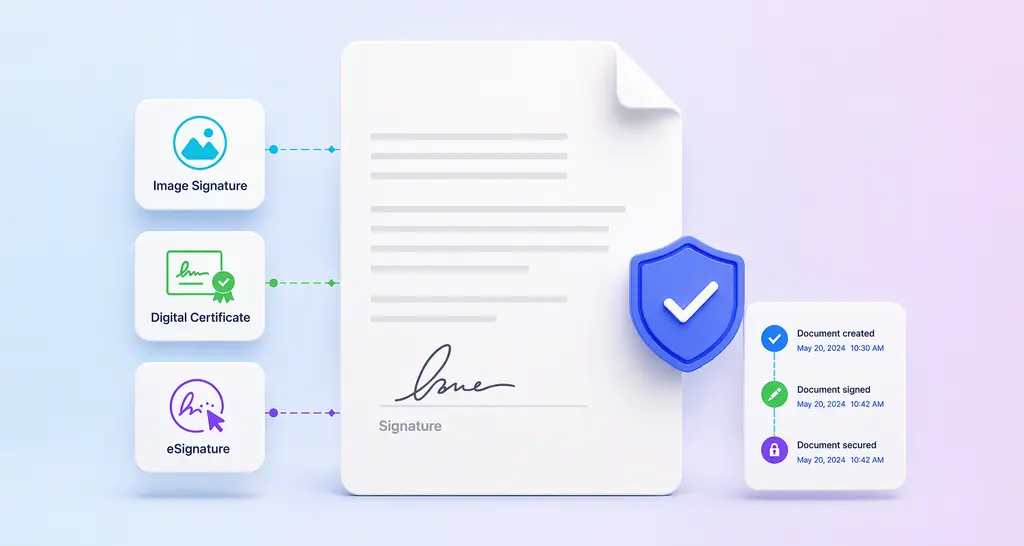
Every document you send gets an audit trail at no extra cost. It records who signed and when, and it arrives as a PDF with the signed document. That record helps when you later need to show which version of an SOW both sides accepted.
Save your standard order form and SOW as reusable templates. You place the fields once, so every new deal starts from your approved wording.
Which BoldSign plan do you need, and what does it cost?
Signing and the audit trail come with every plan. The number of templates is what changes between plans.
The Essential plan is free and includes 2 templates. The Growth plan costs $5 per user a month and includes 10 templates.
The Business plan costs $15 per user a month with unlimited templates. The Premium plan costs $99 a month for unlimited users, also with unlimited templates.
All prices are in USD and billed yearly, as listed on our pricing page in November 2026.
What should you do before your next contract goes out?
Map which of the three documents your deal needs, and ask a lawyer to review the master agreement. Then pick your next step:
- Start a 30-day free trial of BoldSign
- Book a demo to see contract signing with your own documents
- Ask our team a question on the support portal
Frequently asked questions
What is the difference between an MSA and an SOW?
A master service agreement (MSA) sets the legal terms for the whole relationship, such as liability and confidentiality. A statement of work (SOW) describes one project: the tasks, deliverables, dates and sign-off rules.
What is the difference between an order form and an SOW?
An order form records what you buy, how much and at what price. An SOW explains how a piece of work gets done, with deliverables and deadlines.
Do you need a master agreement if you have an order form?
Often, yes. Most order forms leave out liability, intellectual property and disputes, so sellers link them to a master agreement or to standard terms that cover those points.
Which document wins if the MSA and SOW conflict?
The one the contract names. Most master agreements include an order of precedence clause, and many put the master agreement first unless the SOW overrides a named term.
Is an order form a legally binding contract?
Yes, when both sides accept it and it shows a clear deal with agreed terms. The law that governs the deal decides how any missing terms get filled.
Can one master agreement cover many SOWs?
Yes. That is the main reason to have one. You agree the legal terms once, then each new project gets its own short SOW that points back to the master agreement.
Who signs a statement of work?
Usually the same businesses that signed the master agreement, through people with authority to commit budget and staff. The master agreement may say who can approve an SOW.
Can you sign an MSA, SOW and order form electronically?
Yes, when the signers agree to sign electronically. In the US, the Electronic Signatures in Global and National Commerce (ESIGN) Act says a contract cannot be denied legal effect only because it is electronic.

Oliver Malachi Hoka
Oliver Malachi Hoka is a detail-oriented professional with proven experience in office administration, logistics coordination, and HR support. He is skilled in drafting agreements, facilitating company policy training, and managing organizational documentation. Proficient in the Microsoft Office Suite, he excels at fostering teamwork, ensuring compliance, and improving efficiency in fast-paced environments. With strong interpersonal and communication skills, he has a proven track record of building stakeholder relationships and supporting organizational growth.
More posts by Oliver Malachi Hoka