How to Choose Authentication Levels for Internal vs External Approval Documents
 Preethi Loganathan
TL;DR: Pick the authentication level from two facts: how much harm a wrong signature would cause, and whether the signer works for you. Routine internal approvals need an email one-time passcode (OTP) at most. Risky or external approvals need an SMS code, knowledge-based authentication (KBA) or an ID check. Our signer authentication page lists each check.
A department head has to photograph their driver’s license to approve a routine software renewal. The same week, a request to change a vendor’s bank details goes out with only an email link. The heaviest check landed on the document that needed it least.
Picture a sender who picks the check on each send. Internal approvers then wait on checks they never needed.
Meanwhile, the approvals most open to fraud carry the thinnest evidence. This guide gives you a three-tier policy that fixes both problems.
Why does one authentication setting fail for every approval?
One setting for every approval fails in one of two directions. Set it high and routine work slows down; set it low and sensitive approvals carry weak proof.
A high bar turns each code or ID scan into a hurdle for people who sign several requests a week. Requests sit until someone chases them. Stronger checks also cost money per use, so you pay to verify documents that never needed it.
A low bar leaves a disputed payment approval with thin evidence. The record shows that someone with access to an email address signed. It says little about who that person was.
How do you rate the risk of an approval document?
Ask what the approval allows and how easily you could undo it. The more harm a wrong signature could do, the higher the tier.
Work through a few questions for each recurring approval:
- Does it commit spend or bind the company legally?
- Does it change where money goes?
- Does it grant access to sensitive data?
- Could you reverse it quickly if the wrong person signed?
- Does a regulation set its own rule for identifying signers?
Give extra weight to documents that redirect payments, such as vendor bank detail changes. A fraudulent approval of that kind can be hard to reverse once funds move.
Why does it matter whether the signer is internal or external?
A one-time code proves that someone controls an inbox or a phone, not who they are. You already know who owns a company inbox, but an outside email address may tell you little.
Internal signers are employees signing from accounts your organization issues and manages. External signers are everyone else: customers, vendors, contractors and partners.
Internal does not mean low risk, though. An employee releasing a large payment is still a high-risk approval.
A hacked company mailbox also turns an email code into a formality. Recipient type adjusts the method; it never replaces the risk rating.
Which authentication method fits each risk level?
Put the two answers together and you get a simple document risk matrix. Treat each cell as a default that you can move up or down.
| Document risk | Internal approver | External signer |
|---|---|---|
| Low: routine and easy to reverse, such as policy acknowledgments | Email delivery alone, or an email OTP | Email OTP |
| Medium: commits spend or terms, such as purchase requisitions or vendor onboarding forms | Email OTP | SMS OTP, or an access code shared through a channel you trust |
| High: moves money, creates legal exposure or falls under regulation, such as bank detail changes or loan documents | SMS OTP, or ID verification when the approval will face scrutiny | KBA for US signers, or ID verification for proof from an ID document |
A long-standing vendor contact might get an access code you share by phone. An internal workflow that phishing has already targeted can move up a tier.
Write the decision down. List each recurring workflow with its risk tier and its method for internal and external signers. Every sender then gets the same answer, and auditors get something to check the records against.
Is signer authentication required for a legally valid eSignature?
Usually not. The US Electronic Signatures in Global and National Commerce (ESIGN) Act, says a signature cannot be denied legal effect solely because it is electronic.
The statute names no particular authentication method. What authentication changes is how well you can show who approved, and that is often the real question in an audit or a dispute.
A regulation with its own signer identification rule sets your minimum for that workflow. Everything above that minimum is a choice your policy should make on purpose.
What does each authentication method prove?
Each method proves something different and asks a different amount of the signer. Use this table to see the trade-off at a glance.
| Method | What it proves | Effort for the signer | Fits |
|---|---|---|---|
| Email OTP | The signer can open the inbox the request went to | Low: one code from the same inbox | Routine internal approvals, low-risk external documents |
| SMS OTP | The signer holds the phone number you entered, a second channel beyond email | Low to moderate: needs a correct mobile number | Medium-risk external approvals, internal approvals that move money |
| Access code | The signer received a code you shared through a separate channel | Moderate: depends on how you deliver the code | Signers you already reach through a trusted channel |
| KBA | The signer can answer questions drawn from public records, with no ID upload | Moderate: personal details and timed questions, no camera | High-risk approvals with US signers |
| ID verification | The signer matches a government photo ID, with a live selfie check | Higher: needs an ID and a device with a camera | High-value, regulated or fraud-prone approvals |
Is an email OTP enough for external signers?
For low-risk documents, yes. For anything more, add a second channel, because the email code arrives in the same inbox as the signing request.
Anyone who can read the request can usually read the code too. The code still stops a forwarded signing link from working outside that inbox, but it proves little about identity.
An SMS OTP forces a second channel. Someone who gets into a signer’s email still needs their phone. You do need a correct mobile number for every signer before you send.
How do you set signer authentication in BoldSign?
We set authentication per signer, not per document. An internal finance approver can sign with an email OTP while the vendor on the same request passes ID verification.
We offer five checks that line up with the tiers above:
- Email OTP, a code sent to the signer’s inbox
- SMS OTP, a code sent to the signer’s phone
- Access code, a code you choose and share yourself
- KBA, public-record questions for US signers
- ID verification, a photo ID and live selfie
What are the steps to add a check to a signer?
Look up the workflow’s tier in your policy before you start. Then follow these steps:
- Select Create New, then Create New Document, upload the file and add each recipient.
- Open Show settings below the recipient and turn on Authentication.
- Choose the method your policy calls for. For SMS OTP, enter the phone number and country code.
- Repeat for each recipient, since every signer can have a different method.
- Send the request. Each signer must pass their check before the document opens.
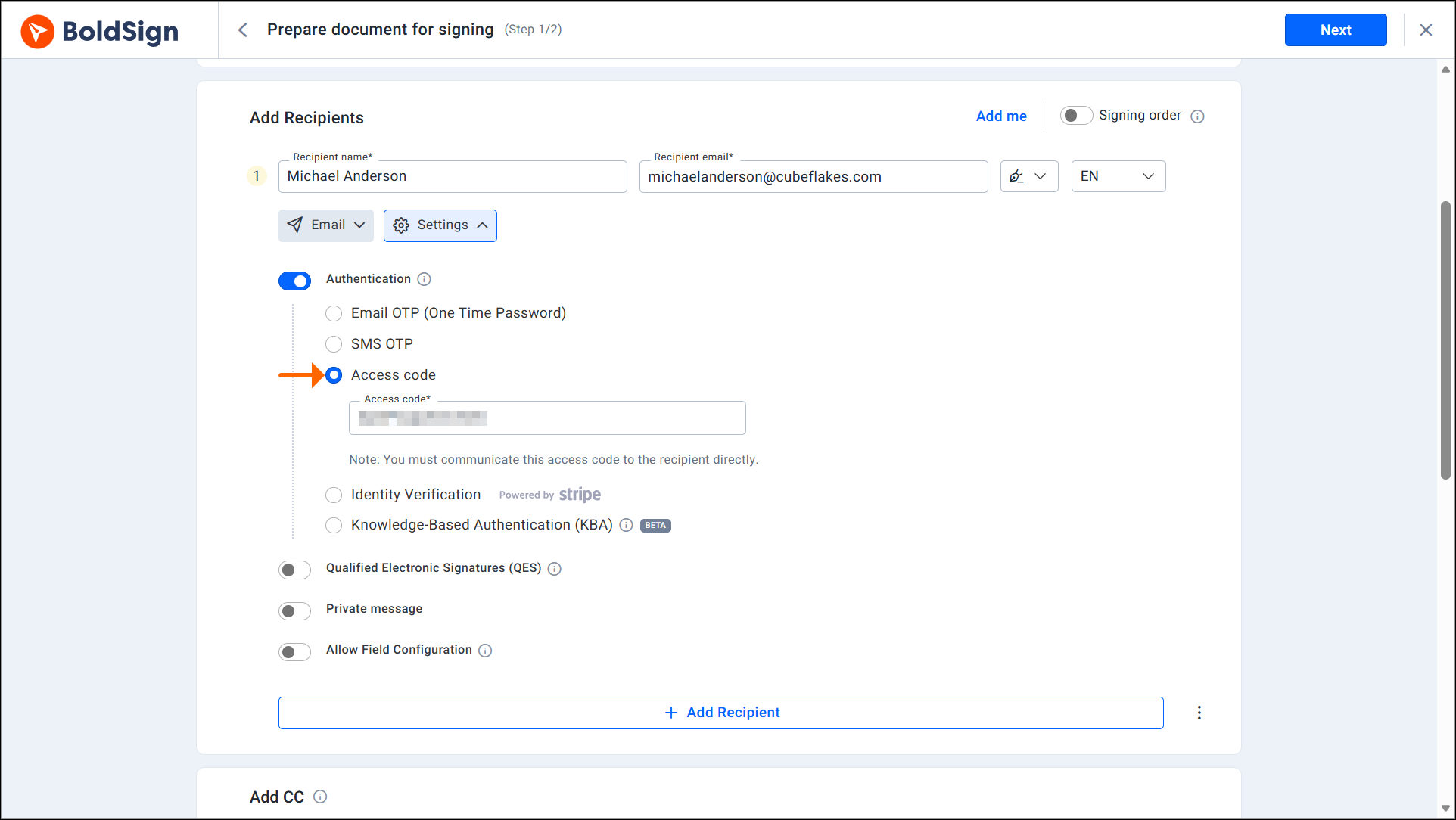
Our help article on how to add authentication to a signer shows each screen. Every check is time-stamped in the document’s audit trail, beside the signature.
Can you add a check after you send?
Yes, as long as that signer has not signed yet. You can add authentication to a request that is already out, with no need to revoke and resend.
Developers can do the same through the API, for example by adding an access code to a sent document.
How do you set up KBA for US signers?
Knowledge-based authentication asks each US signer a few questions drawn from public records before the document opens. Signers enter their legal name, address and the last four digits of their Social Security number first.
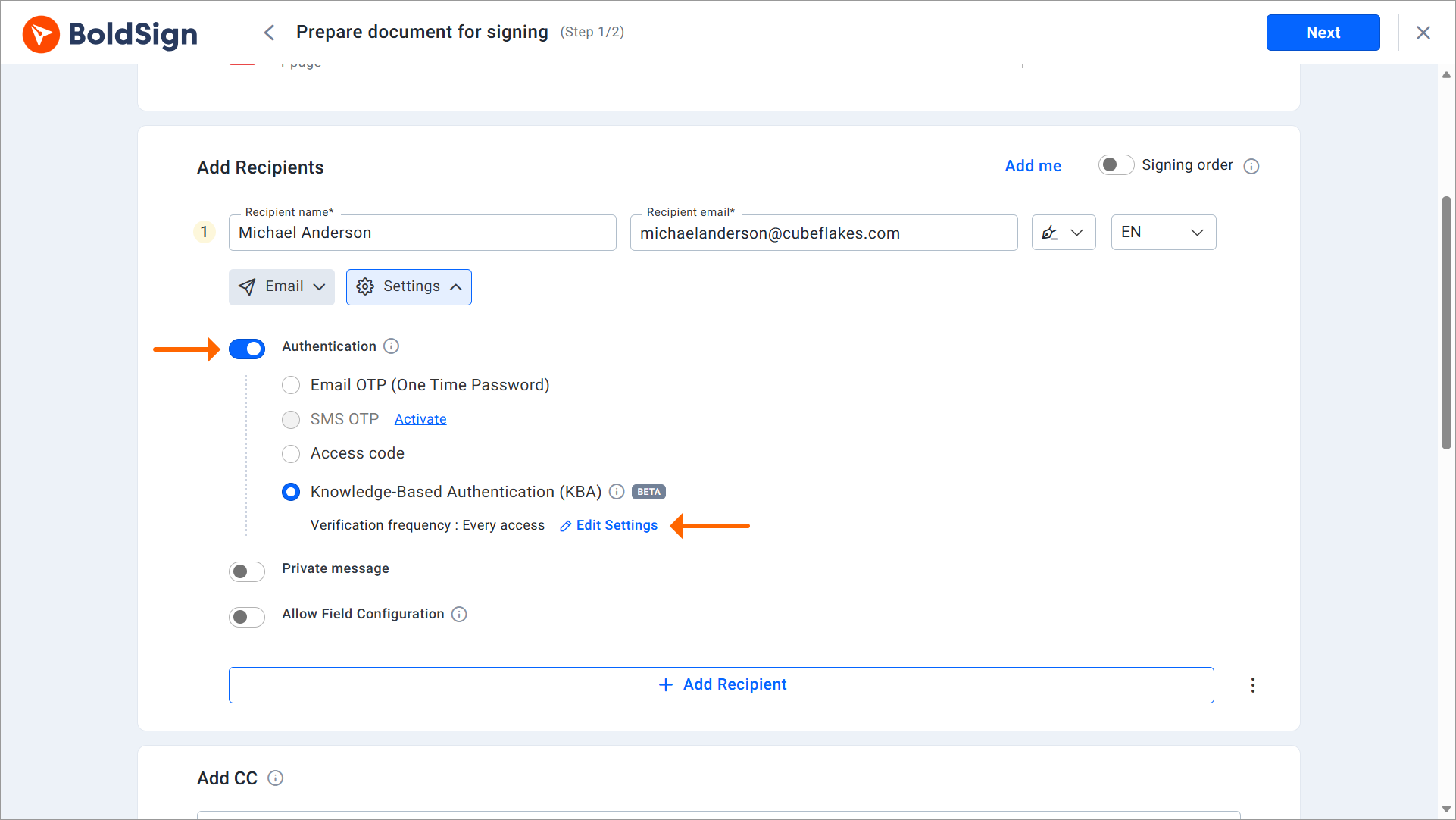
You choose how often the signer must pass KBA and how many attempts they get, from 1 to 3. You also choose how closely the name must match their records.
KBA works only for signers based in the US. Use ID verification for signers in other countries, or when a workflow needs proof from an ID document.
How do you tune ID verification for high-risk approvals?
Signer identity verification asks signers to prove who they are with a government photo ID before the document opens. For the top tier, the settings matter as much as turning it on.
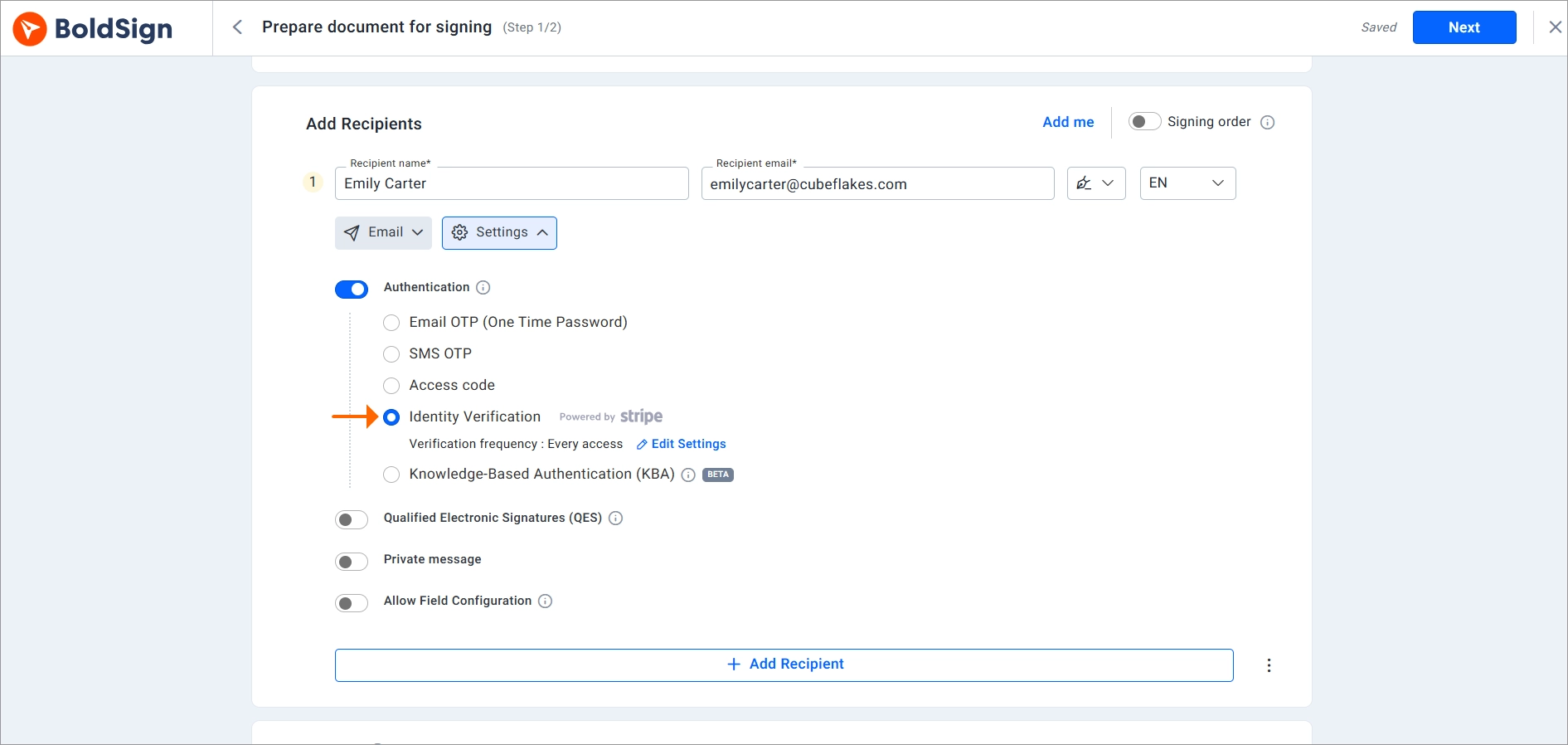
You choose how often signers verify: on every view, once per document, or until signing is complete. You can also cap the attempts and keep the selfie check and live ID capture on.
Match the frequency to the workflow. A regulated approval that signers reopen later may justify a check on every view. A one-time vendor contract usually needs a check only until signing is done.
How do frequency and name matching affect ID verification?
Frequency affects cost. Repeat checks from your frequency setting, and retries, are billed again, as our ID verification FAQ explains.
Strict name matching is the default. Moderate allows differences in middle names, prefixes and suffixes. Lenient also accepts minor spelling differences.
Loosen the match when a signer’s legal name may differ slightly from the contract. That is usually a better fix than dropping the check.
How do you keep the policy the same across senders?
A policy holds up when it does not depend on each sender’s memory. A few tools help.
Developers can tie each workflow’s tier to the check in code, since the API supports all five methods when you create a request. Our guide on how to require signer authentication through the API covers each method. The ID verification API guide shows the high-risk settings.
Approvals that belong to a team can go to a contact group, where any member can sign. Teams building their own apps can use group signers in the API.
How do assistants send approvals for a manager?
An assistant can send approvals in a manager’s name through sender identity. This works through the API, and nothing goes out until the manager approves the request.
The manager gets an email when a document is viewed, signed or completed. They can withdraw the assistant’s access at any time.
What mistakes undo an authentication policy?
Most policies fail through small habits, not big decisions. Watch for these.
Which setup mistakes cause problems?
- Making ID verification the default adds friction and cost to routine approvals. Keep it for the top tier.
- Collecting phone numbers late stalls SMS checks. Confirm the number and country code before you send.
- Sending the access code with the request defeats it. Share it by phone or another channel you trust.
Which habits weaken the policy over time?
- Using KBA for a signer outside the US fails. Check where the signer is based first.
- Treating every internal approval as safe misses risk. An internal approval that releases funds belongs in the top tier.
- Leaving the tiers alone too long lets them drift. Review them after any new workflow, fraud attempt or rule change.
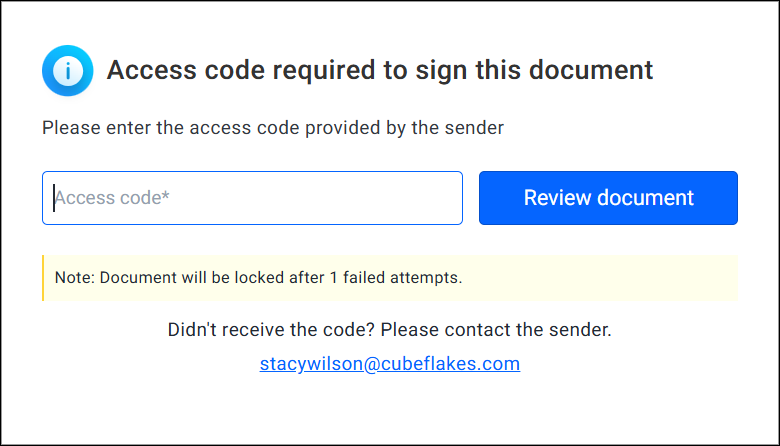
Access codes lock the document after 3 failed attempts. A line in your request message telling signers to expect a check helps avoid lockouts.
Which BoldSign plan do you need, and what does each check cost?
Email OTP and access codes work on every plan, including our free Essential plan. SMS OTP, KBA and ID verification start on the Business plan, as listed on our pricing page in November 2026.
The Business plan costs $15 per user a month, and the Premium plan costs $99 a month for unlimited users. Both prices are billed yearly and are in USD. The Growth plan, at $5 per user a month, includes email OTP and access codes.
KBA costs $1.50 per attempt and ID verification costs $2 per verification, on top of the plan price. Sending live documents through the API needs the Enterprise API plan, from $30 a month with 40 envelopes. You can test first in a free sandbox.
Where do you start with your own authentication policy?
Pick the few approval workflows your team sends most often. Give each a risk tier and a method for internal and external signers, then review after a few weeks.
- Start a 30-day free trial and set a check on your next approval.
- Book a demo to plan the tiers for your own workflows.
- Read our guide to electronic signature authentication methods for more on each check.
Frequently asked questions
What is signer authentication in an eSignature workflow?
Signer authentication is an extra check a signer passes before the document opens. We offer email and SMS codes, an access code you share, knowledge-based authentication (KBA) and ID verification.
Is an eSignature legally valid with only an email link?
Yes, when the signer agrees to sign electronically and you keep the record. Some document types have laws that set their own way to identify signers. Authentication adds evidence of who signed.
What is the difference between a one-time code and identity verification?
A one-time code shows that the signer controls an inbox or a phone. KBA and ID verification go further and check who the person is, through public-record questions or a government photo ID.
When should I use KBA instead of ID verification?
Use KBA for US signers when you want a strong check without an ID photo. Use ID verification for signers outside the US, or when the workflow needs proof from an identity document.
Can each signer on one document have a different check?
Yes. We set authentication per signer, so an employee and a vendor on the same request can each pass a different check.
What happens if a signer fails authentication?
The document locks for that signer after the last allowed attempt. You can then reset the check, change it or remove it so the signer can continue.
Can I add authentication after I send a document?
Yes, as long as that signer has not signed yet. You can add a check in the web app or through our API.
Which BoldSign plan includes SMS codes, KBA and ID verification?
All three start on the Business plan, which costs $15 per user a month, billed yearly. Email codes and access codes work on every plan, including the free Essential plan.

Preethi Loganathan
Preethi is a Digital Marketing Executive at BoldSign who develops precise, research-driven content on eSignatures, compliance, and digital signing workflows. She works closely with product and engineering teams to ensure every article is accurate, validated, and aligned with industry best practices. Connect with her on LinkedIn.
More posts by Preethi Loganathan