Electronic Signature vs Digital Signature: What's the Difference?
 Gayathri Annamalai
TL;DR: An electronic signature is any electronic way a person shows they agree to a document, such as typing a name. A digital signature is one kind of electronic signature. It adds a certificate and math that link the signer to the file and reveal changes. Most documents need only the first, backed by good signer authentication.
You have a contract to send. One tool talks about eSignatures, and your bank asks for a digital signature. Are they the same thing, and which one does your document need?
This guide explains both terms in plain words. It covers what US law says, how each one keeps a document safe, and when you need more than a simple signature.
What is an electronic signature?
An electronic signature is any electronic mark or step you use to agree to a document. Typing your name or clicking “I agree” both count.
Think of signing for a parcel on a courier’s screen. Nobody checks a certificate. What matters is that you meant to accept the parcel.
US law says the same thing in legal words. The Electronic Signatures in Global and National Commerce (ESIGN) Act at 15 U.S.C. 7006 defines an electronic signature as a sound, symbol or process linked to a record.
Under that definition, a person must adopt the signature “with the intent to sign the record.”
Common ways to sign electronically:
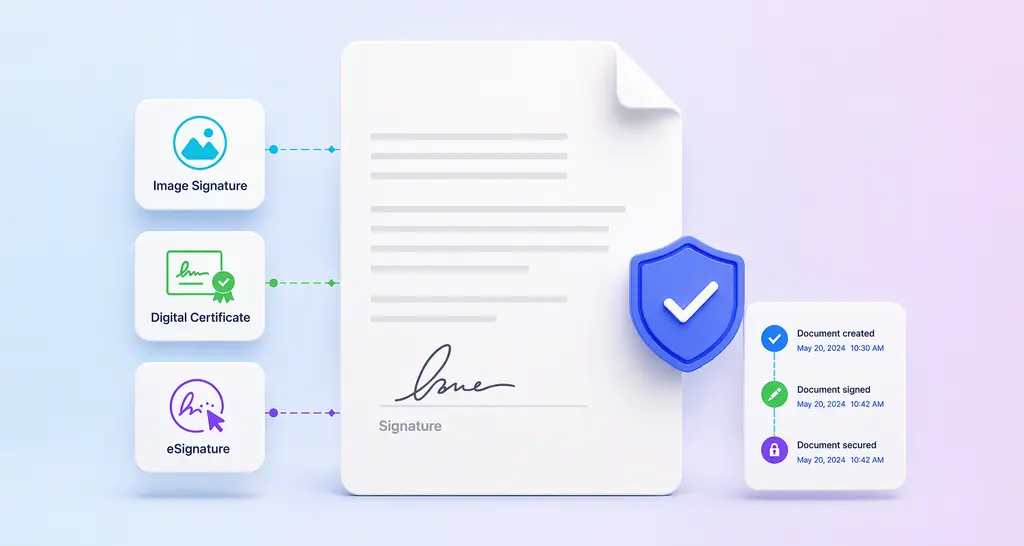
- Type your name in a signature field
- Draw your signature with a mouse, stylus or finger
- Click “I agree” on a form
- Upload an image of your handwritten signature
Read more in our guide on what an electronic signature is.
What are digital signatures, and how do they work?
Digital signatures are electronic signatures made with cryptography, the math behind secure messages. They link the signer to the file and show if anyone changed it later.
Think of a wax seal on an old letter. Anyone can see if the seal is broken. The stamp in the wax also shows who sealed it.
A digital signature works in four steps:
- The software turns the document into a short code called a hash.
- The signer’s private key locks that code. Only the signer holds this key.
- A digital certificate from a certificate authority (CA) links the matching public key to the signer.
- The reader’s software unlocks the code with the public key and compares it with a new hash.
When the two codes match, the file is the one that was signed. The whole system of keys, certificates and CAs is called public key infrastructure (PKI).
Electronic signature vs digital signature: what are the differences?
Electronic signature is the broad idea, and a digital signature is one way to make one. The table shows how the two compare.
| Question | Electronic signature | Digital signature |
|---|---|---|
| What is it? | Any electronic sign of agreement | An electronic signature made with cryptography |
| Main job | Record that you meant to sign | Link the signer to the file and show changes |
| How is it made? | Typing, drawing, clicking or uploading | A private key, a hash and a certificate |
| Who is the signer? | Proven by the signing process, such as an email code | Proven by the certificate |
| Are changes visible? | Depends on the signing platform | Yes, the check fails after a change |
| Typical use | Everyday business documents | Filings and files that need a certificate |
A short way to remember it: an electronic signature is about intent, and a digital signature adds proof built into the file.
What is the difference between electronic signatures and digital signatures in legal terms?
In US federal law, “electronic signature” is the legal term, and the ESIGN Act defines it by intent. “Digital signature” is a technical term for one method, so the law treats it as one kind of electronic signature.
The definition names no encryption, certificate or software. A typed name and a certificate-based signature both qualify when the person means to sign.
The general rule sits in 15 U.S.C. 7001(a). A signature or contract “may not be denied legal effect, validity, or enforceability solely because it is in electronic form.”
Some agencies, industries and countries set their own rules for certain records. Check the rule for your document before you choose a signing method.
When is an electronic legal signature enough?
An electronic legal signature fits most everyday business paperwork. What helps most is a clear record of who signed, when and how.
Standard electronic signatures suit documents like these:
- Sales contracts and customer agreements
- Offer letters and HR onboarding forms
- Policy acknowledgments and consent forms
- Internal approvals
Add stronger checks when fraud or a dispute would cost a lot. Government filings, banking documents, court papers, tax forms and high-value contracts often call for an ID check or a certificate.
How secure are electronic signatures compared with digital signatures?
The two build trust in different ways. An electronic signature relies on the signing process, while a digital signature carries its proof inside the file.
A well-run electronic signing process records several things:
- How the signer proved who they were, such as a code sent by email
- A timestamp for each step
- An audit trail of who opened, viewed and signed
- Who can see the document
A digital signature adds a certificate and a hash to the file itself. Any change after signing makes the check fail when someone opens the file.
What do people get wrong about electronic and digital signatures?
Three mix-ups come up again and again. Each one leads people to pick the wrong method.
- “Electronic signatures are not secure.” Sign-in checks and an audit trail give them solid proof.
- “Every legal document needs a digital signature.” Only some rules ask for one.
- “The two terms mean the same thing.” A digital signature is one kind of electronic signature.
How does BoldSign handle electronic signatures and digital signatures?
We sign with simple electronic signatures (SES) by default, backed by signer checks and an audit trail. When a signer needs a qualified certificate, you can turn on a qualified electronic signature (QES) for that signer.
Our audit trail records each signer’s name, email, internet protocol (IP) address and device, with timestamps. It also notes how each signer proved who they were. Our eSignature features list the other tools, and our security policy explains how we protect your data.
For a BoldSign QES, a qualified trust service provider checks the signer’s ID and issues their certificate. After the QES, we seal the document with an Entrust certificate. We do not offer the advanced electronic signature (AES) level.
Which BoldSign plan do you need, and what does it cost?
Every BoldSign plan includes an audit trail, email authentication and tamper-proof documents. ID verification, SMS authentication and a qualified electronic signature (QES) need the Business or Premium plan.
Here is what each plan costs, billed yearly, as listed on our pricing page in November 2026. Prices are in USD.
- The Essential plan is free.
- The Growth plan costs $5 per user a month.
- The Business plan costs $15 per user a month.
- The Premium plan costs $99 a month for unlimited users.
On the Business plan and up, the QES add-on costs $3 per signing attempt, charged whether the attempt succeeds or fails.
You can start with a 30-day free trial.
How do you choose the right signature for your documents?
Start with what your document needs: intent, identity or a qualified certificate. Then pick the next step that fits you.
- Start a 30-day free trial and send your first document.
- Book a demo to talk through signer checks and QES for your team.
- Ask a question on our support portal, where our team answers by chat, email and ticket.
Frequently asked questions
What is the main difference between an electronic signature and a digital signature?
An electronic signature is any electronic way to show you agree to a document. A digital signature is one kind of electronic signature. It uses a certificate and math to link the signer to the file and show later changes.
Is a digital signature a type of electronic signature?
Yes. Every digital signature is an electronic signature. It adds a certificate and a check that shows if the file changed after signing.
Are electronic signatures legally valid?
Yes, when the person signs with the intent to sign. In the US, the Electronic Signatures in Global and National Commerce (ESIGN) Act says a signature cannot lose legal effect just for being electronic.
Is a digital signature legally binding in the US?
Yes, when the signer adopts it with the intent to sign. US federal law treats it like any other electronic signature. The certificate adds proof, but intent is what the law asks for.
How does a digital signature show that a document changed?
The software makes a short code, called a hash, from the file at signing. Later it makes the code again. A different code means someone changed the file.
Do all documents need a digital signature?
Only when a law, an agency or the other party asks for one. Most sales contracts, offer letters and consent forms work well with a standard electronic signature and an audit trail.
Can a business use both electronic and digital signatures?
Yes. Many teams use standard electronic signatures for daily paperwork. They add stronger checks, such as an ID check or a qualified signature, for the few documents that need them.
Does BoldSign offer qualified electronic signatures?
Yes. A qualified electronic signature (QES) is an add-on from our Business plan, at $3 per signing attempt. A trust service provider, not us, checks each signer and issues their certificate.

Gayathri Annamalai
Gayathri Annamalai is a software developer with 1 year of experience at BoldSign. She enjoys continuous learning, strengthening her technical skills, and exploring new tools and technologies. She also has an interest in writing clear and helpful content for developers. Connect with her on LinkedIn.
More posts by Gayathri Annamalai