How Nonprofits Increase Pledge Completion Rates with BoldSign
 Lakshmi Priya Soundar Rajan
TL;DR: Nonprofits raise pledge completion rates by making the pledge easy to sign and hard to forget. Send the pledge form to sign online, set automatic reminders, and check who still needs a nudge. Our eSignature for nonprofits page explains the free plan for verified groups.
A donor fills in a pledge card at your spring gala and promises a monthly gift. The card goes into a box, then a pile, then an email thread. By the time someone follows up, the donor has forgotten the details.
This guide explains what pledge completion rates measure and why pledges stall. It then shows how to set up a digital pledge form that donors can finish in a few minutes.
What is a pledge completion rate?
A pledge completion rate is the share of pledged gifts that donors actually complete. Your rate is 80% when 100 donors pledge and 80 follow through.
Think of it like the guest list for a dinner. Everyone who said yes is a pledge, and everyone who turns up is a completion. The gap between the two is the work your team chases.
A higher rate makes your income easier to forecast. It also gives your board clearer campaign reports and saves staff hours spent chasing forms.
Why do pledge completion rates drop?
Most pledges stall because the next step is slow or unclear. A donor who meant to give simply runs out of time or loses track.
The usual causes are simple:
- Paper pledge cards that need printing, signing, scanning or posting.
- Forms that sit in long email threads where newer versions replace older ones.
- No reminder when a pledge form is still unsigned.
- Unclear amounts, dates or next steps on the form itself.
Your team feels it too. Staff follow up by hand when there is no single view of each pledge, and they lose time for fundraising.
How do eSignatures help nonprofits improve pledge completion?
Electronic signatures remove the printing and posting step, so a donor can finish a pledge in one sitting. They also keep a record of each step, which makes follow-up simpler.
Donors sign in minutes, from any device
Donors open the pledge form from a link and sign on a phone, tablet or computer. They need no account, and our mobile app lets staff send and track forms on the go.
Automatic reminders do the chasing
You can turn on automatic reminders when you send a form. Choose the days between reminders and up to 5 reminders in total.
Staff see who has signed
Each form shows whether the donor has viewed or signed it. Your team can follow up only with the donors who still need it.
Required fields catch missing details
Mark the amount, schedule and contact fields as required. The donor cannot finish until each one is filled in, so fewer forms come back incomplete.
Every signed pledge keeps a record
Each signed form comes with an audit trail that lists the signer, the time and the device. Our guide on why audit trails matter explains how to use that record.
How do you set up a digital pledge workflow with BoldSign?
Start from the pledge card you already use. Most teams can send their first digital pledge form in an afternoon.
- Upload your pledge form.
- Add the signature, amount and date fields, and mark the ones donors must fill in.
- Turn on automatic reminders in the document settings, then send the form.
- Check each donor’s status, and save the form as a template for the next campaign.
Our guide on how to save time with templates shows the template step in detail. You can also send the form by email, SMS or WhatsApp through our delivery options.
How do nonprofits use BoldSign across a pledge campaign?
The same pledge form works at an event, in a follow-up email and in a large appeal. Here is how each stage fits.
Collect pledges at events
Send the pledge form to a donor’s phone while they are still at the event. Donor interest is highest in that moment, so the pledge is signed before the evening ends.
Reach large donor lists
Bulk send sends one pledge form to many donors, each with their own copy. Bulk links give you one link to share in a newsletter or on social media.
Add a check for large gifts
Some major gifts call for an extra identity step. Signer authentication can ask the donor for an access code or a one-time code before they open the form.
Set up forms faster
Artificial intelligence (AI) form field detection finds the blanks on an uploaded form and suggests fields. You check them and adjust before sending.
What should you watch out for with digital pledge forms?
A signed pledge is a promise, not a payment. We handle the signed form and its record, while your payment or donor management tool still collects the gift.
Keep the form short and clear. State the amount, the schedule and how the donor will pay, so the signed record matches what they expect.
Check your local rules for gift agreements before you rely on e-signed pledges for large or legacy gifts. Our guide to nonprofit board approvals covers signing on the governance side.
Which BoldSign plan do you need, and what does it cost?
A small fundraising team can start for free. Larger campaigns that use bulk send need a paid plan, which verified nonprofits get at half price.
What do our plans cost?
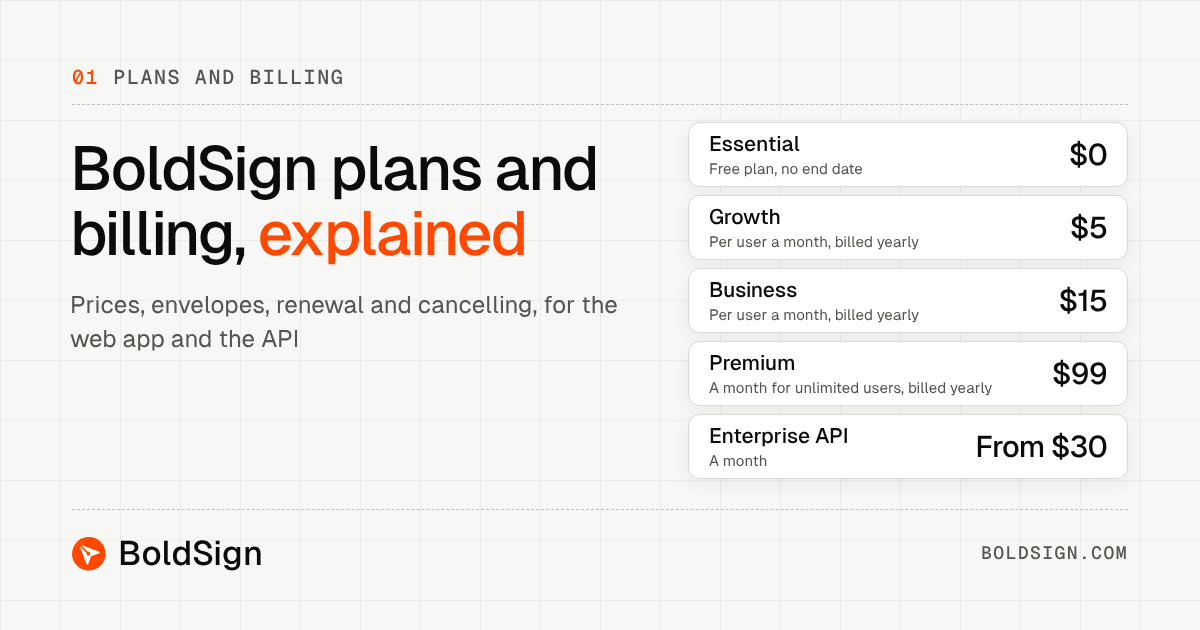
Our regular prices are in USD and billed yearly. The Essential plan is free, and the Growth plan is $5 per user a month.
The Business plan is $15 per user a month, and the Premium plan is $99 a month for unlimited users. You can try them first with a 30-day free trial.
What do verified nonprofits pay?
The Growth plan is free for one user at a verified nonprofit, and each extra user costs $5 a month. The Business plan is $8 per user a month, and the Premium plan is $50 a month, billed yearly.
Our guide to free software for nonprofit organizations explains the offer and how to apply.
Which plan fits a pledge campaign?
- The Growth plan includes 50 envelopes a month, 10 templates and in-person signing.
- The Business plan adds bulk send and bulk links, each at $0.25 per envelope.
- The Business plan also adds SMS and WhatsApp delivery, ID verification and AI field detection.
How do you start raising your pledge completion rate today?
Pick the pledge form your team sends most and move it online first. Send it to one colleague, then to your next group of donors.
- Start a 30-day free trial and send your first pledge form.
- Book a demo to see a pledge campaign set up live.
- Read how to simplify volunteer agreement signatures for your next event.
Frequently asked questions
What is a pledge completion rate?
It is the share of pledges that donors follow through on. The rate is 80% when 100 donors pledge and 80 complete their gift.
Why do donors leave pledges unfinished?
Most often the form is hard to finish or easy to forget. Paper cards, long email threads and no follow-up give a busy donor time to move on.
Is an electronically signed pledge form legally binding?
Yes, when the donor agrees to sign electronically and you keep the signed record. Check the rules for your country and gift type, mainly for large or legacy gifts.
Do donors need a BoldSign account to sign a pledge?
No. Donors sign from the link we send them, on a phone or a computer. Only your staff who send forms need a seat.
How many reminders can BoldSign send to a donor?
You can set up to 5 automatic reminders per document. You pick the number of days between them when you send the form.
Does BoldSign collect the pledged money?
No. We handle the signed pledge and its record. Your payment or donor management tool still takes the gift itself.
Can a donor sign a pledge card at a fundraising event?
Yes. Donors can sign on their own phone from a link, or on a staff tablet with in-person signing. In-person signing starts on the Growth plan.
Is BoldSign free for nonprofits?
Our Growth plan is free for one user at a verified nonprofit. Each extra user costs $5 a month, and our Business and Premium plans are 50% off.

Lakshmi Priya Soundar Rajan
Lakshmi Priya Soundar Rajan is a Technical Writer at BoldSign. With expertise in simplifying complex concepts, she contributes to the comprehensive documentation and user-friendly content at BoldSign. Lakshmi’s commitment to quality ensures users have access to clear and helpful information. Connect with her on LinkedIn.
More posts by Lakshmi Priya Soundar Rajan