
How to Spot Home Improvement Contract Scams Before You Sign
 Meikanda Nayanar
TL;DR: A home improvement contract scam is a repair or remodel offer built to take your money without a written record. Most warning signs from the Federal Trade Commission (FTC) point to one habit: skipping the paperwork. A signed contract, a fair payment schedule and a tamper-evident audit trail are what protect you.
A roofer knocks after a storm and offers a good price if you decide today. He wants cash, and he says the contract can come later. Offers like this cost homeowners their deposits every year.
This guide covers the warning signs the FTC lists. It also shows what a fair contract and change order look like, so you can check both before you pay.
What is a home improvement contract scam?
A home improvement contract scam is a deal where the contractor takes your money and skips the work, or does far less. The scam works by keeping the agreement vague and unwritten.
Think of a restaurant bill with no menu prices. You find out what the meal costs only after you have eaten it. A contract with no written scope or price works the same way.
What are the red flags of a home improvement scam?
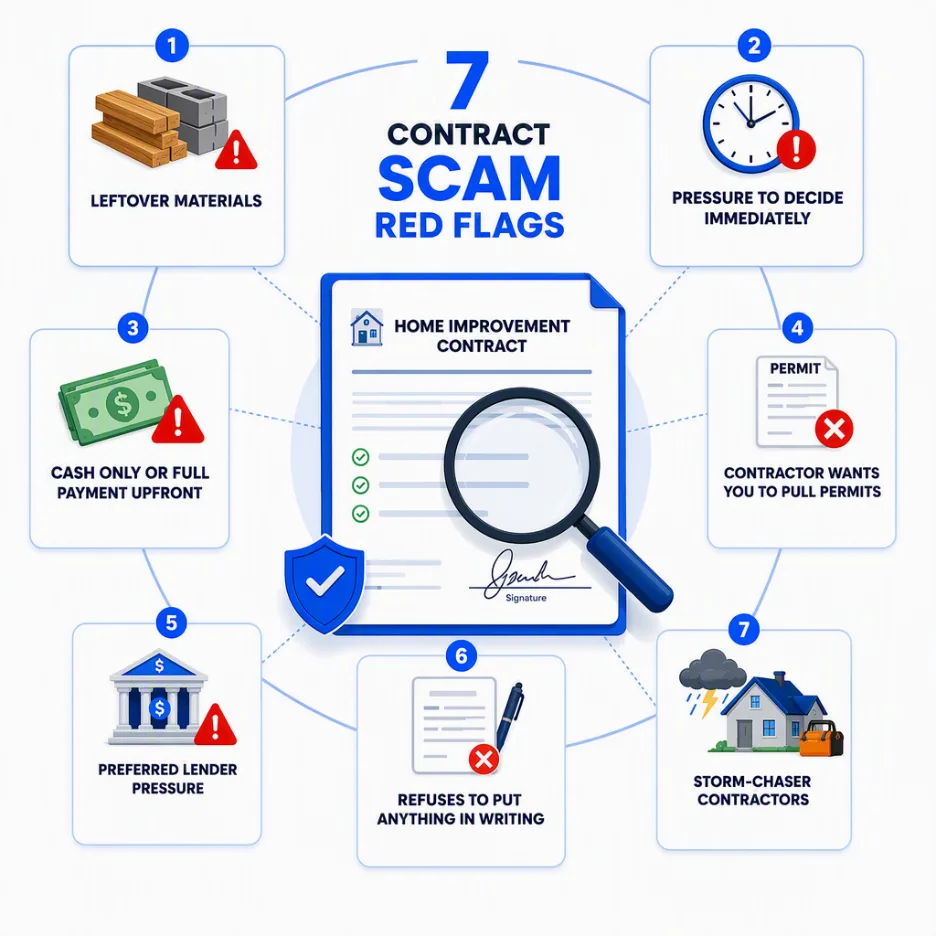
The FTC lists the first four signs in its guide on how to avoid a home improvement scam. Watch for a contractor who:
- Says there are materials left over from another job nearby.
- Asks you to pay everything upfront, or accepts only cash.
- Asks you to get the required building permits yourself.
- Suggests you borrow from a lender the contractor knows.
The lender sign carries the biggest risk. The FTC warns that papers signed in a hurry can turn out to be a home equity loan with high fees, secured on your house.
Which other warning signs should you watch for?
Three more signs come up again and again. Pressure to decide today is the first, since a rushed buyer skips the reference checks. A refusal to put the estimate, contract or changes in writing is the second.
A crew that turns up at your door after a storm is the third. Many storm crews are honest, but a dishonest one counts on you being in a hurry.
Why does a scam depend on skipping the paperwork?
A written record makes both sides accountable. A signed contract fixes the price and the scope before money moves, and a permit puts the work on a public register.
Each document gives you something to point to later. An honest contractor gets the same protection.
A person who plans to take your deposit and leave cannot afford any of that. So a push to skip the paperwork is the scam itself, and impatience has little to do with it.
How much should you pay a contractor upfront?
Pay a reasonable deposit and keep most of the price for later. Some states cap the down payment a contractor may ask for, so check with your state or local consumer agency first.
Tie each payment to a stage of finished work. Keep the final payment until the job is done and you are happy with it. That last payment gives you the most pull once the crew is on site.
Pay in a way you can trace. The FTC advises paying by credit card or check. A wire transfer, gift card, payment app, cryptocurrency or cash is hard to get back.
How do you check a contractor before you sign?
Check the license and insurance first, then the reputation. The FTC suggests working only with contractors who hold both a license and insurance.
- Confirm the license with your state or county government.
- Ask for proof of insurance in writing.
- Get three written estimates and compare what each one covers.
- Ask people you trust for referrals, and ask each contractor for references.
- Search the company name with words such as “complaint” or “review”.
Your local consumer protection office can tell you if anyone has filed complaints. The FTC consumer advice site is a good place to start looking for your state’s rules.
What should a home improvement contract include?
A fair contract answers who, what, how much, when and how changes work. Ask about any blank line before you sign.
- The contractor’s legal name, address, phone number and license number.
- The work, the materials and anything left out of the job.
- The total price, the deposit and a payment schedule tied to stages.
- A start date and an expected finish date.
- Who gets the permits, and how changes will be priced and signed.
The FTC also warns against signing anything with blank spaces. A blank line can be filled in later with terms you never agreed to.
Can you cancel a contract signed at your home?
Often you can, within three business days. The FTC’s cooling-off rule covers many sales made away from the seller’s place of business, including at your home.
The rule is in Part 429 of Title 16 of the Code of Federal Regulations (CFR). It covers purchases of 25 US dollars or more made at your home. Elsewhere away from the seller’s business, the threshold is 130 US dollars.
You may cancel before midnight of the third business day after the sale. The seller must give you a written notice of cancellation when you sign. The rule has exceptions, so read the definitions in section 429.0 or ask your state consumer office.
Why does every change need a signed change order?
Almost every job changes partway through, and that alone is no warning sign. What matters is a signed record of each change before the extra work starts.
A wall opens and there is rot behind it. You pick a different tile. A change order is the short document that records the new work, the new cost and the new finish date.
Both sides sign it before the work happens. A contractor who handles changes with a phone call and a promise is setting up an argument.
A signed change order protects an honest contractor too. It proves you approved the extra work before the contractor paid for materials and labor.
Why are scams more common after storms?
Crews that follow the weather are a steady pattern, so the FTC keeps separate advice on scams after weather emergencies. After a storm you face damage, an insurer and a deadline at once.
The rules stay the same, and they matter more. Check the license and insurance as usual. Pay a fair deposit by card or check, and get every promise in writing.
Is it safe to sign a home improvement contract electronically?
Yes. An electronic signature leaves a stronger record than ink on paper, since each step is logged as it happens.
- A seal on the signed PDF shows any change made after signing.
- The audit trail logs when the document was sent, viewed and signed.
- The Electronic Signatures in Global and National Commerce Act (ESIGN) makes these signatures enforceable in the US.
The Uniform Electronic Transactions Act (UETA) gives the same effect under state law. Our page on UETA and ESIGN Act compliance explains both. In the European Union, the electronic identification, authentication and trust services (eIDAS) rules recognize simple electronic signatures.
Our feature page lists what each signed document includes. Builders can see how this fits their work on eSignature for Construction.
What does it cost to sign contracts with BoldSign?
You can sign and send contracts for free. Our Essential plan costs nothing and covers 25 envelopes a month for one user.
The Growth plan costs $5 per user a month, billed yearly, and covers 50 envelopes a month. Prices are in USD, as listed on the BoldSign pricing page in November 2026. Paid plans start with a 30-day free trial.
What do you do if a contractor has scammed you?
Stop any payment you still can, and keep every record. Save documents, photos, emails, chat messages and voicemails.
Report it to your local police and your state consumer protection office. Then file a report with the FTC at ReportFraud.ftc.gov.
Take a contract you now doubt to a lawyer or your state consumer protection office, and keep the contractor out of that review. Nothing on this page is legal advice.
How can you put your next home project in writing?
A fair contractor has no reason to avoid a signature. We let you and your contractor sign contracts and change orders online, with a record of who approved what and when.
- Start a 30-day free trial and send your first contract for signature.
- Try the Change Order Agent demo, one of our eSignature agents, to see a chat assistant send a change order.
- Read what unsigned change orders cost before your next job starts.
Frequently asked questions
What are the biggest red flags of a home improvement scam?
The Federal Trade Commission (FTC) warns about contractors who want full payment upfront or cash only. Claims of leftover materials, asking you to get the permits and steering you to their own lender are warning signs too.
How much should I pay a contractor upfront?
Pay a reasonable deposit, never the full price. Some states cap the down payment a contractor may ask for, so check with your state consumer agency. Hold the final payment until the work is done and you are happy with it.
How do I verify a contractor is legitimate?
Confirm the license with your state or county government and ask for proof of insurance. Then get three written estimates, ask people you trust for referrals and look for complaints filed against the company.
Is a verbal agreement with a contractor enforceable?
Yes, when your state's law accepts it, but a spoken deal is hard to prove later. Put the scope, price, dates and every change in a signed document instead. That record settles most disputes.
How do I spot surprise fees, change orders, and common scams in new home builder agreements?
Read the price section for allowances and extra charges, and ask how each one is set. Check that every change needs a signed change order with its own price. Treat pressure to sign fast or pay in cash as a warning sign.
What is a change order, and why does it matter for scams?
A change order is a short signed document that updates the contract when the job changes. It records the new work, cost and dates, so surprise charges cannot appear on the final bill.
Is it safe to sign a construction contract electronically?
Yes, when the signature meets the ESIGN Act and UETA rules in the US, as most electronic signatures do. A signed document also carries a seal that shows any change made after signing.
A contractor wants payment by wire transfer or gift card. What should I do?
Stop and pay nothing yet. The FTC advises paying by credit card or check, since a wire transfer or gift card is hard to get back. Report the request at ReportFraud.ftc.gov.

Meikanda Nayanar
A veteran product manager at BoldSign, boasting a decade-long journey as a .NET developer. With a rich history of leading product development across diverse technologies like Windows Forms, WPF, UWP, Xamarin.Forms, Flutter, and MAUI, Meikandan brings a unique blend of technical expertise and strategic insight to the table. Connect with him on LinkedIn.
More posts by Meikanda Nayanar