How to Automatically Upload Signed Documents to Dropbox with Zapier
 Lakshmi Priya Soundar Rajan
TL;DR: A ready-made Zapier template uploads every signed BoldSign document to Dropbox on its own. The Document Completed trigger starts the Zap, and the Upload File action saves the file to a folder you pick. Our Zapier integration page lists every trigger and action.
Think of an office manager who files each signed lease by hand. She opens the email, downloads the PDF, finds the right Dropbox folder and uploads it. When the week gets busy, a lease or two never reaches the folder.
A Zap does that filing for you. This guide shows how to set up the template, test it and avoid the usual mistakes.
What does the Zapier Dropbox template do?
The template links BoldSign to Dropbox, so each completed document uploads to a Dropbox folder. You set it up once, and Zapier runs it each time a document is signed.
A standing order at your bank works the same way. You fill in the form once, and every later payment goes out without another visit.
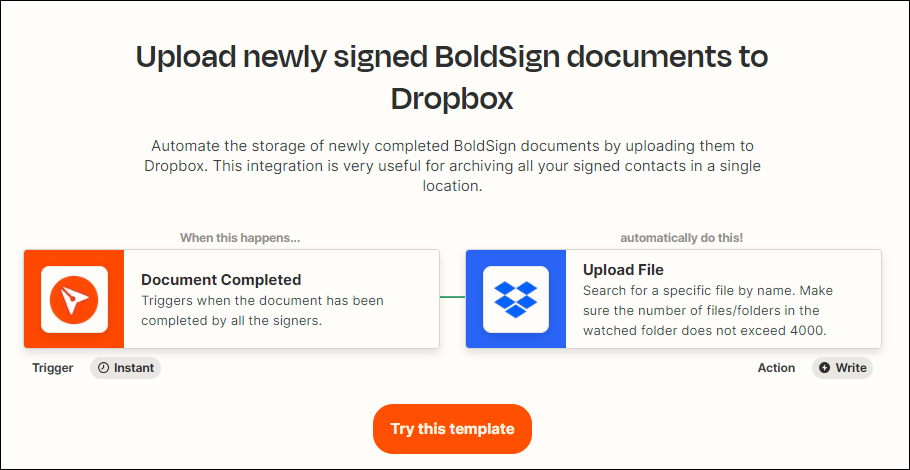
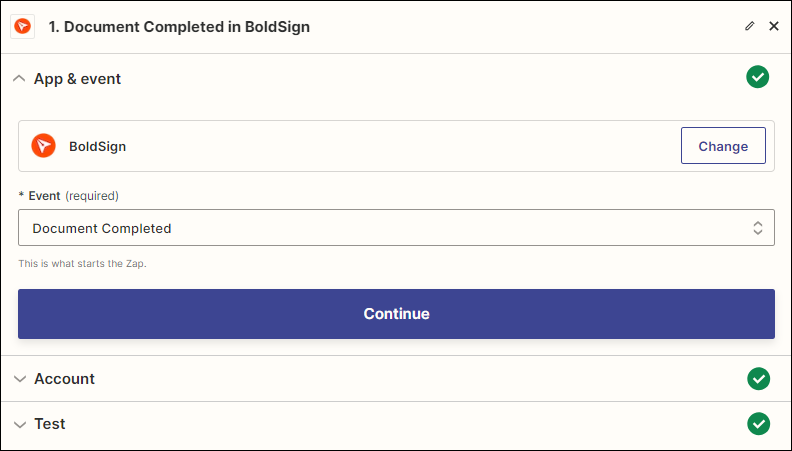
The Zap has two parts. The trigger is the BoldSign event called Document Completed. The action is the Dropbox event called Upload File, which puts the signed file in your folder.
You can find this template among others in BoldSign’s Zapier app listing.
What do you need before you start?
You need three accounts, and the Zap connects to each one. Set them up first so the editor can reach them.
- A Zapier account to build and run the Zap.
- A Dropbox account with a folder for signed files.
- A BoldSign account: a paid API account or a free sandbox account.
No BoldSign account yet? Create a free API sandbox account to build and test the Zap before it runs live.
How do you upload signed documents to Dropbox with Zapier?
Start from the template, connect each account, then test the Zap. The whole set-up happens inside the Zapier editor.
Set up the BoldSign trigger
- Go to the Upload newly signed BoldSign documents to Dropbox page and click Try this template.
- Check the App & event section. BoldSign and the Document Completed event are already filled in.
- Connect your BoldSign account in the Account section.
- Test the trigger in the Test section. Zapier then shows your latest completed document.
Set up the Dropbox action
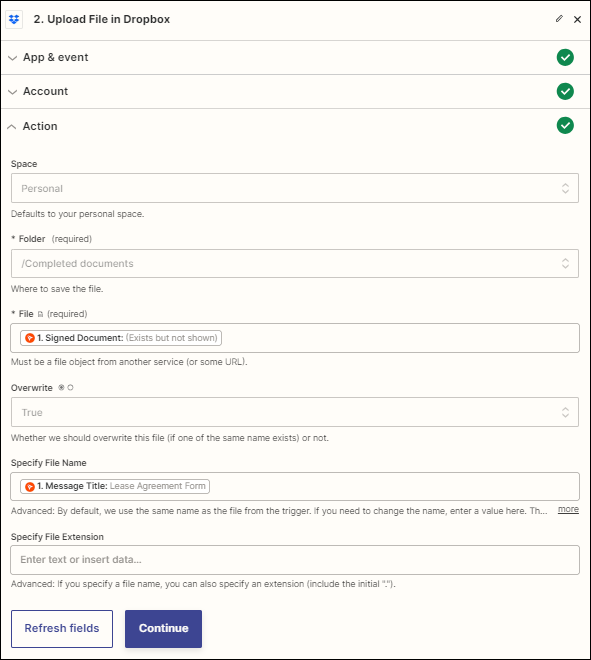
- Check the App & event section. Dropbox and the Upload File event are already filled in.
- Connect your Dropbox account in the Account section.
- In the Folder field, choose where the signed documents should go.
- Fill in any other required fields.
Test and publish the Zap
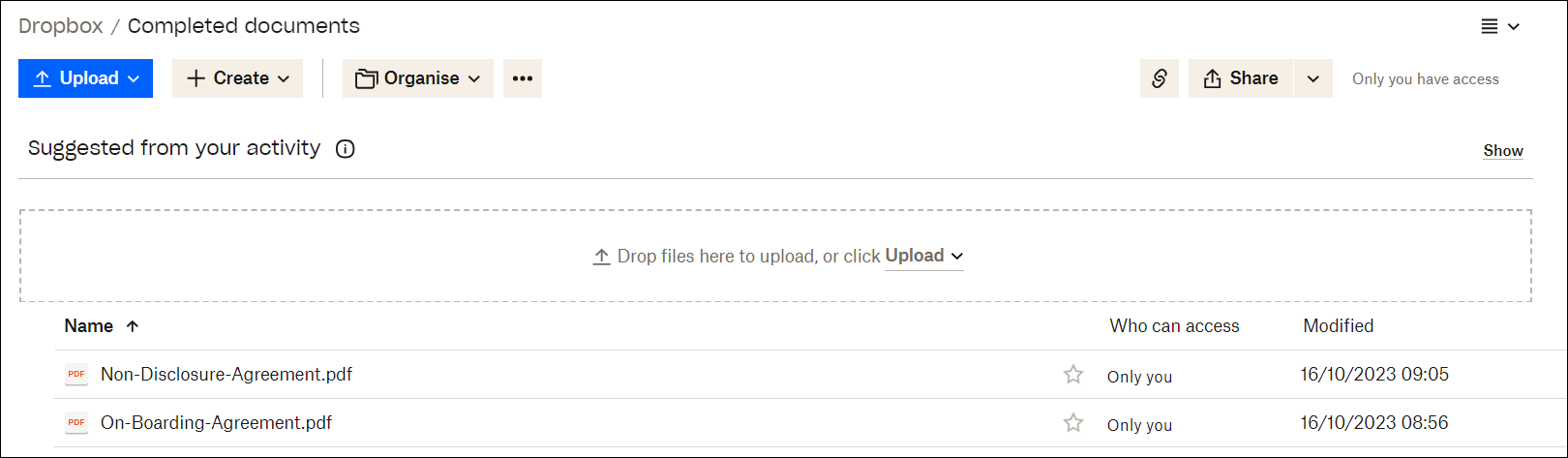
- Test the action in the Test section. Your latest completed document should appear in the Dropbox folder.
- Check the details, then click Publish.
- Find your new Zap on the Zaps page in Zapier.
From now on, each document you complete in BoldSign lands in that folder.
What should you watch out for?
A few settings decide whether the Zap runs as you expect. Check them before and after you publish.
- Set Sandbox Mode to true while testing, so no envelope is used.
- Switch Sandbox Mode to false once the Zap is ready for real documents.
- Turn on Admin mode in the trigger to catch documents your whole organization sends.
- Ask your admin for the View Document permission to save a teammate’s signed PDF.
- Expect sandbox documents to carry a test watermark and leave BoldSign after 14 days.
Our support team can help when a Zap still fails.
Can you save signed documents to Dropbox without Zapier?
Yes, our automatic cloud backup saves completed documents to Dropbox, Google Drive or OneDrive from your BoldSign settings. Our guide to auto backup of signed documents shows how an admin connects it.
Zapier suits you when the upload is one step in a bigger workflow. The same template idea works for Google Drive and OneDrive too.
For more ideas, read how to automate your eSignature workflows with BoldSign integrations on Zapier. You can also send eSignature requests for new RowShare entries.
Which plan do you need, and what does it cost?
Live Zaps need our Enterprise API plan, from $30 a month with 40 envelopes and $0.75 per extra envelope. You can build and test the Zap first in a free sandbox account, with no credit card.
Automatic cloud backup without Zapier comes with the Business plan at $15 per user a month. The Premium plan costs $99 a month for unlimited users. Both are billed yearly in USD, as listed on our pricing page in November 2026.
How do you start sending signed files to Dropbox?
Pick the step that fits where you are today.
- Start a 30-day free trial and send your first document for signature.
- Book a demo to see Zapier and cloud backup set up for your team.
- Read the Zapier articles in our knowledge base for each trigger and action.
Frequently asked questions
Can Zapier save signed documents to Dropbox?
Yes. A ready-made Zap takes each completed BoldSign document and uploads it to the Dropbox folder you choose. You set it up once in the Zapier editor.
Do I need to write code to connect BoldSign and Dropbox?
No. You build the Zap by picking apps, events and a folder in Zapier. The template fills in the trigger and the action for you.
Which BoldSign trigger starts the Dropbox Zap?
The Document Completed trigger starts it. Only fully signed documents reach Dropbox, so drafts and declined requests stay out of the folder.
Can I test the Zap without using an envelope?
Yes. Set the Sandbox Mode field to true while you test. Change it to false once the Zap should run with real documents.
Can the Zap upload documents my teammates send?
Yes, when you turn on Admin mode in the trigger and hold the View Document permission. Admin mode picks up documents from your whole organization.
Can I back up signed documents to Dropbox without Zapier?
Yes. Our automatic cloud backup sends completed documents to Dropbox from your BoldSign settings. It covers documents completed after an admin turns it on.
How long do sandbox test documents last?
Sandbox documents carry a test watermark, and we delete them after 14 days. Use them to check the Zap, then switch to live documents.
Which BoldSign plan do I need for Zapier?
Live Zaps need the Enterprise API plan, from $30 a month with 40 envelopes. A free API sandbox account lets you build and test the Zap first.

Lakshmi Priya Soundar Rajan
Lakshmi Priya Soundar Rajan is a Technical Writer at BoldSign. With expertise in simplifying complex concepts, she contributes to the comprehensive documentation and user-friendly content at BoldSign. Lakshmi’s commitment to quality ensures users have access to clear and helpful information. Connect with her on LinkedIn.
More posts by Lakshmi Priya Soundar Rajan